
Three years after undergoing a kidney transplant, a patient developed a severe wound infection. Multidrug-resistant bacteria caused the wound to ulcerate and continuously discharge pus, leaving clinicians with few effective treatment options. Yet following an innovative therapy, the long-standing, non-healing wound closed completely within just three weeks.
At Zhongshan Hospital, Fudan University, stories like this are becoming increasingly common.
The driving force behind these remarkable recoveries is not a new generation of antibiotics, but bacteriophages—naturally occurring viruses that specifically infect and destroy bacteria.
From Broad-Spectrum Killing to Precision Targeting
Antimicrobial resistance (AMR) has become one of the greatest global public health challenges of our time. As multidrug-resistant “superbugs” continue to emerge, the effectiveness of conventional antibiotics is steadily declining. This trend not only increases mortality from common infectious diseases such as pneumonia but also places surgeries, chemotherapy, organ transplantation, and other life-saving medical procedures at significantly greater risk of infection.
Today, the development of new antibiotics is struggling to keep pace with the rapid evolution of bacterial resistance.
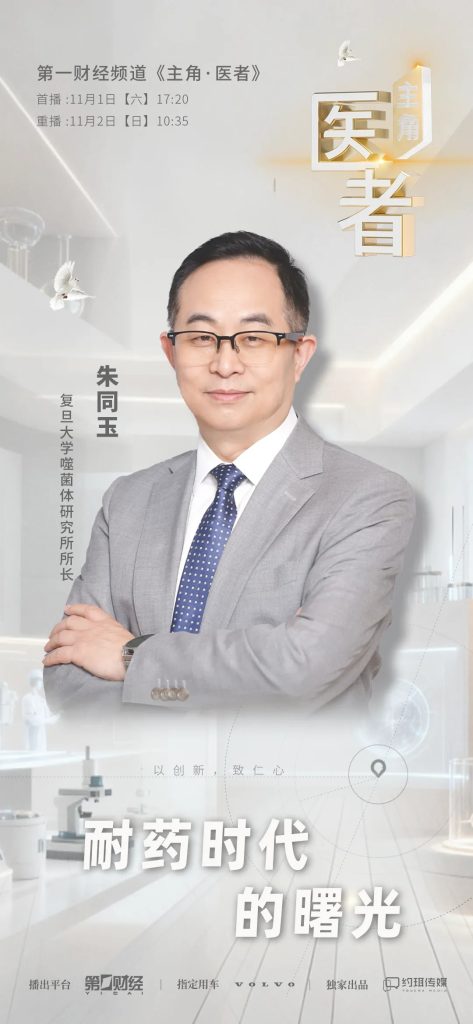
Professor Tongyu Zhu, Director of the Fudan University Institute of Bacteriophages and Academic Leader of the Kidney Transplantation Program at Zhongshan Hospital, Fudan University, explains:
“Globally, only one or two new antibacterial drugs are introduced each year, while dozens of new drug-resistant bacterial strains emerge during the same period.”
Against this daunting challenge, bacteriophage therapy is emerging as a promising solution, offering a highly targeted approach to combating bacterial infections.
Traditional antibiotics function much like indiscriminate carpet bombing. While they eliminate pathogenic bacteria, they also destroy beneficial microorganisms that are essential for maintaining the body’s microbial balance.
Bacteriophage therapy, by contrast, represents a new paradigm of precision targeting.
Professor Zhu explains:
“Bacteriophages attack only harmful bacteria while leaving normal human cells—and beneficial bacteria—largely unharmed.”
This extraordinary specificity reflects one of nature’s own ecological mechanisms. Virtually every bacterial species has one or more naturally occurring bacteriophages that act as its biological predators.
Even more remarkably, bacteriophages are not foreign to the human body—they are among its most abundant natural inhabitants.
Professor Zhu notes:
“If you sequence the human gut microbiome, you’ll find that the vast majority of viral genetic material belongs to bacteriophages. They quietly help maintain the healthy balance of our microbial ecosystem.”
Rather than disrupting the body’s microbiota, bacteriophages work in harmony with it, selectively eliminating pathogenic bacteria while preserving beneficial microbial communities. This unique characteristic has positioned bacteriophage therapy as one of the most promising next-generation strategies in the fight against antimicrobial resistance.
Bringing New Hope to Patients with Once-“Untreatable” Infections
How does this innovative therapy perform in real-world clinical practice?
A growing number of remarkable patient recoveries are providing compelling evidence of its therapeutic potential. At Zhongshan Hospital, the bacteriophage therapy program led by Professor Tongyu Zhu has already transformed the lives of numerous patients suffering from severe, drug-resistant infections.
Professor Zhu recently shared the story of Mr. Chen, a patient who arrived at Zhongshan Hospital several months ago in search of what he believed was his last chance.
“Dr. Zhu, the infection on my abdomen keeps getting worse. I can’t even take a shower anymore, and it hurts just to lie down. Please, can you help me?”
Covering two large infected lesions on his abdomen, Mr. Chen sought help with a sense of desperation.
Upon examination, Professor Zhu found that chronic abdominal wall abscesses accompanied by granulomatous tissue had progressively destroyed large areas of the surrounding skin. The extent of the infection was striking.
Mr. Chen had undergone a kidney transplant seven years earlier. Two years before visiting Zhongshan Hospital, he began suffering recurrent infections involving the transplanted kidney and abdominal wall. Laboratory testing identified multidrug-resistant Escherichia coli as the causative pathogen.
Despite receiving multiple courses of broad-spectrum antibiotics and undergoing three surgical debridement procedures, the infection remained persistent and difficult to eradicate.
After carefully reviewing his medical history, Professor Zhu’s team isolated the patient’s bacterial strain and performed precise bacteriophage matching using the hospital’s phage library. They identified highly lytic bacteriophages specifically capable of targeting the pathogen.
Working much like peeling away the layers of an onion, the bacteriophages gradually dismantled the infection.
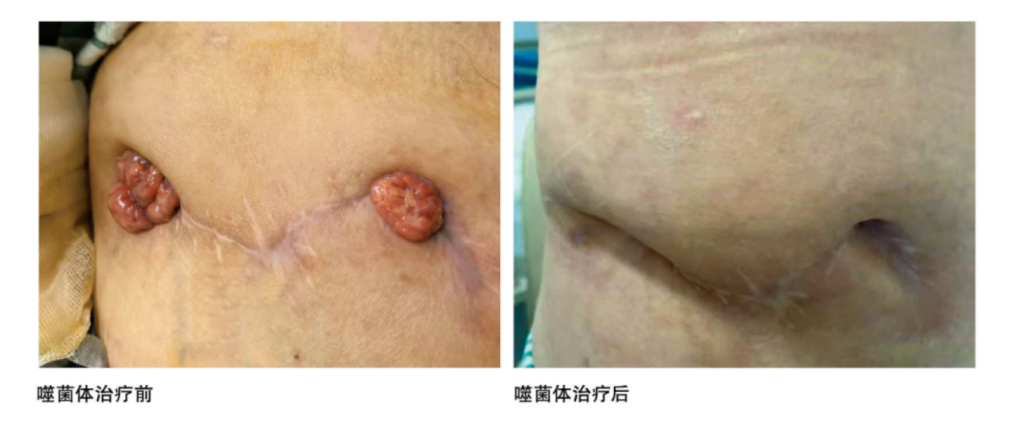
Following several rounds of localized bacteriophage therapy, Mr. Chen’s chronically ulcerated wound contracted and healed completely within just three weeks. The underlying infectious lesions were dramatically reduced, and antibiotic therapy was no longer required.
Another patient, who traveled from Xinjiang, had endured complicated urinary tract infections for more than twelve years. At the peak of the illness, the patient needed to urinate nearly 80 times every day, making normal life almost impossible.
After three months of bacteriophage therapy, the infection was successfully controlled. More importantly, the patient regained a normal quality of life and eventually fulfilled a long-held dream of embarking on a self-driving road trip across China.
To date, Zhongshan Hospital has accumulated experience from more than 300 successful bacteriophage treatment cases. Behind every case is a patient whose life has been given a new beginning.
Predicting Resistance Before It Happens
Given such encouraging clinical outcomes, one important question naturally arises:
If bacteria can develop resistance to antibiotics, could they also become resistant to bacteriophages?
The team at Zhongshan Hospital has already developed a comprehensive strategy to address this challenge.
Their approach is known as bacteriophage cocktail therapy, in which three or more carefully selected bacteriophages are combined to form a multi-layered therapeutic defense.
This “combined-arms” strategy enables multiple bacteriophages to attack different bacterial strains simultaneously while greatly reducing the likelihood that bacteria will develop resistance to all of them at once. As a result, both the efficacy and the clinical applicability of bacteriophage therapy are substantially enhanced.
For liver and kidney transplant recipients suffering from multidrug-resistant infections, clinicians first isolate the pathogenic bacteria from the patient. The bacterial isolate is then screened against the hospital’s extensive bacteriophage library to identify the most effective phages. Based on these results, researchers formulate a personalized bacteriophage cocktail specifically tailored to the patient’s infecting strain.
Through extensive laboratory research, the team has also begun to predict the evolutionary pathways of common drug-resistant bacteria, allowing them to anticipate resistance patterns and intervene earlier with optimized therapeutic strategies.
Beyond bacteriophage cocktail therapy, the team’s current research increasingly focuses on the development of engineered bacteriophages.
Leveraging artificial intelligence–assisted screening and other cutting-edge biotechnologies, researchers are redesigning bacteriophages to further expand their therapeutic capabilities.
Unlike naturally occurring phages, engineered bacteriophages can be optimized to improve bacterial killing efficiency, broaden antibacterial activity, and enhance both stability and safety in clinical applications.
These advances are placing bacteriophage therapy at the forefront of next-generation precision antimicrobial medicine.
Redefining Infection Control
Perhaps even more significant than its therapeutic success, bacteriophage technology is reshaping the very philosophy of infection prevention and control.
Professor Zhu believes that the traditional concept of disinfection—which aims to eliminate all microorganisms indiscriminately—should be reconsidered.
“Beneficial microorganisms are not our enemies. Precision disinfection using bacteriophage-based disinfectants represents a far more scientific approach.”
Zhongshan Hospital has already begun piloting bacteriophage spray disinfection in hospital wards.
Unlike conventional disinfectants, bacteriophage sprays selectively eliminate multidrug-resistant bacteria while preserving beneficial microorganisms in the surrounding environment.
Professor Zhu explains:
“After conventional disinfection, people are usually advised not to touch treated surfaces immediately. With bacteriophage sprays, however, patients can interact with their surroundings normally. Whenever harmful bacteria appear, the bacteriophages will automatically recognize and attack them.”
Inside Zhongshan Hospital’s laboratories, researchers continue collecting wastewater samples to isolate and purify new bacteriophages, constantly expanding the hospital’s growing bacteriophage repository.
From fundamental scientific discovery to clinical application, bacteriophage therapy is opening an entirely new chapter in precision antimicrobial medicine.
Looking to the future, Professor Zhu remains optimistic.
“The future of bacteriophage therapy lies in standardized, large-scale clinical application. Working together with antibiotics, bacteriophages will become a powerful complementary force in combating bacterial infections.”